by muckbivi83
Madocho Sends Subliminal Shots at VJ Patelo, Advises Youth on Hard Work
Madocho Sends Subliminal Shots at VJ Patelo, Urges Youth to Work Hard and Avoid Patelo’s Ways
Controversial content creator and street commentator Madocho has once again sparked online debate after appearing to throw subliminal shots at VJ Patelo, while at the same time delivering a strong message to the youth about hard work, discipline, and self-respect.
In a recent online appearance that quickly gained traction across social media platforms, Madocho stopped short of directly naming VJ Patelo but made remarks that many netizens interpreted as clearly aimed at him. His message centered on criticizing lifestyles he believes glorify shortcuts to success, public attention-seeking, and what he described as “misleading influence on young people.”
“Hard Work Still Matters”  Madocho’s Message
 Madocho’s Message
Madocho emphasized that today’s youth should focus on building skills, working consistently, and maintaining good character, instead of chasing clout or copying behaviors they see online without understanding the consequences.
“Not everything you see online should be copied. Some paths look flashy but lead nowhere,” he stated, in what many took as a thinly veiled jab at Patelo’s public persona.
According to Madocho, success that comes without effort rarely lasts, and young people should be cautious about who they choose as role models in the digital age.
Netizens React
As expected, the comments section quickly turned into a battleground. Some fans applauded Madocho for speaking uncomfortable truths, saying his advice was timely given the growing influence of social media personalities on young audiences. Others, however, accused him of throwing shade instead of addressing issues directly, arguing that subliminals only fuel unnecessary drama.
Supporters of VJ Patelo defended him, saying everyone has a right to express themselves and make a living in their own way, as long as they are not harming others.
Bigger Conversation on Influence
Beyond the personalities involved, the exchange has reignited a wider conversation about responsibility, influence, and mentorship among public figures. With many young people looking up to online creators for guidance and inspiration, the question remains:
Who should the youth listen to, and what values should be promoted?

Kenya has sent 230 more elite officers to Haiti to boost the fight against gangs and restore order
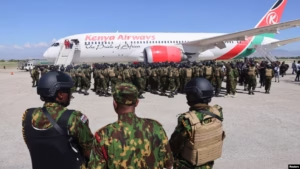
Kenya has deployed an additional 230 specially trained police officers to Haiti, strengthening its role in the ongoing international effort to stabilize the Caribbean nation. This latest contingent is part of Kenya’s continued reinforcement of the Gang Suppression Force (GSF)—a multinational mission tasked with restoring order, curbing gang violence, and supporting humanitarian access in areas long plagued by insecurity.
The newly deployed officers include experts in urban combat, intelligence gathering, counter-gang tactics, humanitarian coordination, and community stabilization, making them a vital boost to the existing teams already operating in Haiti. Their arrival underscores Kenya’s commitment to global peacekeeping and South-South cooperation, positioning the country as a key player in international security operations.
Kenya’s involvement comes at a time when Haiti continues to battle escalating gang activity, displacement of civilians, and limited government control. The GSF—made up of forces from Kenya and partnering nations—aims to reclaim critical infrastructure, reopen schools and hospitals, and support the Haitian National Police (HNP) in rebuilding a functional security framework.
Officials say the added personnel will help expand ongoing operations in heavily affected regions, support rapid-response missions, and increase patrol presence to protect civilians. The reinforcement also signals Kenya’s intention to sustain the mission until stability improves and Haitian institutions can fully take charge.
As global attention turns toward Haiti, Kenya’s leadership is seen as both courageous and transformative, marking one of the most significant African-led international security interventions in recent history.

IEBC Chairperson Erastus Ethekon: “Stealing an Election in Kenya Is Impossible

Independent Electoral and Boundaries Commission (IEBC) Chairperson Erastus Ethekon has strongly defended the credibility of Kenya’s electoral system, insisting that the idea of rigging or manipulating results is “an impossibility” under the current framework.
Speaking during a media briefing, Ethekon emphasized that Kenya’s elections are safeguarded by multiple layers of transparency, oversight, and public participation, making it extremely difficult for anyone to tamper with the process.
“To steal an election in this country is an impossibility. Our officers, observers, and the media who witnessed these elections can confirm that it is impossible,” he said.
Ethekon highlighted several key factors that ensure the integrity of the vote:
1. Technology-Driven Transparency
The use of electronic voter identification and real-time transmission of results from polling stations has significantly reduced loopholes that were previously exploited. Each polling station’s results are transmitted directly to the national tallying center, minimizing human interference.
2. Presence of Observers and Media
Local and international observers, alongside accredited media houses, monitor the process from start to finish. According to Ethekon, this widespread visibility makes it impossible for anyone to manipulate numbers unnoticed.
3. Publicly Displayed Forms
Polling station results are openly displayed and copies shared with party agents, creating a public trail that can be cross-checked at any time. This ensures that the results announced nationally match those recorded at the grassroots.
4. Strict Audit Trails
Every step of the electoral process—including ballots, forms, and electronic systems—leaves an audit trail that can be independently verified by stakeholders.
Ethekon assured Kenyans that IEBC remains committed to conducting free, fair, and credible elections, urging citizens to trust the systems in place.
“As a country, we have grown. Our institutions have become stronger, and our people are more informed. No one can steal an election under such conditions,” he noted.
His remarks come at a time when election integrity continues to be a major point of discussion in Kenya’s political landscape. The IEBC hopes that increased transparency and reforms will continue to build public confidence ahead of future elections.

Kenyan Creators Shine at 2025 TikTok Awards SSA: A New Era of Digital Icons

Kenyan creators were among the continent’s brightest stars at the 2025 TikTok Awards Sub-Saharan Africa, held in Johannesburg, South Africa. Under the vibrant theme “New Era, New Icons,” this year’s ceremony paid tribute to Africa’s most influential digital creatives — the trendsetters shaping how the world sees African culture, humour, fashion, music, and social impact.
The event delivered a powerful blend of glitz, innovation, and raw talent, spotlighting both rising stars and established creators who continue to push the boundaries of online storytelling. From eye-catching fashion moments on the red carpet to high-energy performances that lit up the auditorium, the awards marked a defining moment for Africa’s booming creator economy.
Hosted by the dynamic Bontle Modiselle-Moloi, the show attracted an impressive lineup of African stars. Music sensation Ciza, creative powerhouse Lord Kez, Thuli P, DJ Fif_Laa, and vocalist Thabsie kept the atmosphere electrifying. The night also featured special appearances from celebrated sprinter Akani Simbine and digital darling Mihlali Ndamase, who surprised fans as guest presenters.
For Kenyan creators, the ceremony was more than an award night—it was a symbol of global recognition. Their consistent dominance on the platform, unique content styles, humorous skits, viral dance trends, and community-driven storytelling continue to place Kenya at the heart of African digital culture. This year’s nominations and wins reaffirm their impact across the continent and beyond.
As TikTok expands its influence and investment in Africa’s creative economy, the 2025 awards underscored one clear message: African creators are not just participating in global trends—they’re leading them.

Most Watched Kenyan Artists on YouTube in 2025 (Top 10 Ranking)

Kenya’s music scene continues to dominate East Africa, and 2025 has already proved how powerful digital platforms—especially YouTube—have become for artists. From Gengetone to Rumba, Gospel, and Afro-pop, Kenyan musicians are pulling record-breaking numbers and gaining global attention.
Below is the official Top 10 Most Watched Kenyan Artists on YouTube in 2025, based on total accumulated YouTube views.
TOP 10 MOST WATCHED KENYAN ARTISTS ON YOUTUBE (2025)
1. Sofiya Nzau – 147 Million Views
Sofiya continues her global domination after going viral with “Mwaki”, putting Kenyan vocals on the international map. Her consistency and massive cross-border fanbase make her the undisputed queen of YouTube in 2025.
2. Bien – 108 Million Views
Bien’s solo career is unmatched. His songwriting genius and live performance energy keep his releases trending instantly.
3. Prince Indah – 86 Million Views
The King of Luo Ohangla! Prince Indah has turned traditional rhythms into global content, attracting millions with every new release.
4. Willy Paul – 85.2 Million Views
Love him or hate him, Pozze is a powerhouse. His mix of gospel roots and secular hits keeps his numbers rising every year.
5. Toxic Lyrikali – 73.8 Million Views
A fast-rising star bringing street anthems and relatable lyrics. 2025 is proof that consistency pays off.
6. Otile Brown – 65.6 Million Views
Smooth vocals, clean visuals, and a loyal fanbase. Otile remains one of Kenya’s strongest digital performers.
7. Sauti Sol – 59.2 Million Views
Even on a break, the legendary group’s music still dominates. Their timeless hits keep accumulating millions yearly.
8. Msanii Group – 56.7 Million Views
A new entry shaking up the industry with unique collaborations and viral content.
9. Guardian Angel – 53 Million Views
Gospel heavyweight with unmatched YouTube loyalty—his fans always show up.
10. Wakadinali – 52.6 Million Views
The kings of Kenyan hip-hop. Their raw storytelling and massive street support keep them trending.
🎯 Why These Artists Are Winning on YouTube
-
High-quality music videos
-
Cross-genre collaborations
-
Loyal fanbases (local + diaspora)
-
Viral TikTok moments pushing traffic to YouTube
-
Consistent releases
YouTube has officially become the biggest platform for Kenyan music, and these numbers show just how much the industry has grown.

Derek Chauvin Files New Appeal in George Floyd Murder Case, Citing Flawed Testimony and Due Process Violations

Derek Chauvin, the former Minneapolis police officer convicted of second-degree murder in the death of George Floyd, has filed a new appeal in an effort to overturn his conviction and secure a retrial. According to filings submitted last month in Hennepin County District Court, Chauvin argues that several legal and procedural errors compromised the fairness of his trial.
In the appeal, first reported by Fox News, Chauvin claims that the court relied on flawed medical testimony when establishing the cause of Floyd’s death. He disputes the conclusions of four physicians who reviewed the medical examiner’s findings, accusing them of using methods that leaned heavily on video evidence rather than widely accepted scientific practices. Chauvin says he now has expert witnesses prepared to testify that the methodology used by those doctors is not standard within the medical community.
Beyond the medical debate, Chauvin also takes aim at testimony from Minneapolis Police Department supervisors, who told the court that kneeling on a suspect’s neck was not part of MPD training. The filing now includes sworn statements from 34 current and former Minneapolis officers who say the maneuver was indeed taught during use-of-force training — a key point Chauvin believes undermines the prosecution’s argument that he violated departmental policy.
Chauvin further claims the court violated his constitutional right to due process, arguing that the jury received improper instructions and that the intense public scrutiny surrounding the case created an environment that prevented an impartial verdict.
Chauvin is currently serving two sentences: a 21-year federal sentence for violating George Floyd’s civil rights, and a 22.5-year state sentence for second-degree murder. He is being held at a low-security federal prison in Big Spring, Texas, with a scheduled release date of 2038.
The appeal is the latest development in a case that sparked global protests, ignited conversations about policing and racial justice, and remains one of the most defining moments in recent American history. Chauvin’s legal challenge is expected to draw significant public attention as the court reviews whether any of his arguments warrant reopening one of the most consequential cases of the decade

Kenya Won’t Walk Away From Haiti, We’ll Continue Offering Support President Ruto

President William Ruto has reaffirmed Kenya’s commitment to helping restore peace and stability in Haiti, stating that the country will not abandon the embattled Caribbean nation despite the challenges facing the multinational security mission.
Speaking during a high-level briefing, Ruto emphasized that Kenya’s involvement is not an act of charity but a demonstration of global solidarity and responsibility. He noted that Haiti, long plagued by gang violence, political turmoil, and humanitarian crises, needs steadfast international partners—and Kenya intends to remain one.
Ruto highlighted that Kenya’s police deployment, part of a UN-backed mission, aims to support Haitian authorities in reclaiming peace and rebuilding institutions weakened by years of instability. He assured that the mission would continue to be guided by strict operational standards, respect for human rights, and collaboration with global partners, including the United States, CARICOM nations, and the UN.
The President further dismissed claims that Kenya might withdraw due to logistical, legal, or financial hurdles. Instead, he stated that Kenya’s role represents a broader vision of African leadership on the world stage—proving that African nations can meaningfully contribute to international peace and security.
Ruto also called on the international community to honor its commitments, provide adequate funding, and accelerate humanitarian interventions, especially for the millions of Haitians facing displacement, hunger, and violence.
As discussions continue globally on the long-term stability of Haiti, Kenya’s position sends a strong message: partnerships rooted in mutual respect and global responsibility remain essential in confronting modern security challenges.

Gachagua opens DCP doors to leaders dissatisfied within ODM

As the political landscape shifts ahead of 2027, Gachagua’s remarks reflect a broader realignment in Kenya’s opposition politics. The tension within ODM underscores a deeper ideological fracture between those aligning with the government for strategic leverage and those insisting on maintaining firm opposition integrity.
This moment presents Gachagua as not merely a critic of President Ruto—but as a political architect offering sanctuary and strategy to leaders who feel politically orphaned by the turbulence within their mother parties. His message is clear: DCP is positioning itself as a stable home for dissenters and principled leaders alike.
Political analysts suggest that if senior figures like Sifuna and Babu Owino were indeed removed or isolated within ODM, their migration to DCP, or allied opposition parties, could embolden a new counter-force to Kenya Kwanza’s influence. Gachagua appears intent on transforming DCP from a factional outfit into a national opposition powerhouse—capitalizing on disillusionment, resentment, and shifting loyalties.
Yet, this move also signals a calculated challenge to Ruto’s power projection, especially in regions historically aligned with Raila Odinga. The alleged attempt by Ruto to sway ODM leadership, if true, may weaken its traditional grassroots loyalty and open up political vacuum—one Gachagua is ready to fill.
In a season where alliances are transactional and loyalty is increasingly fluid, Gachagua is betting on political refuge as a winning strategy. The question now becomes: will ODM withstand internal pressure and preserve its identity, or is Kenya witnessing the birth of a new political order forged through unexpected collaborations?
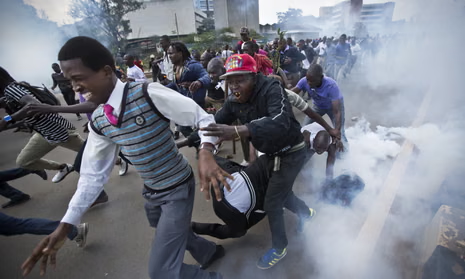
Seven Arrested After Kariobangi Church Chaos as Political Tensions Intensify


The National Police Service (NPS) has confirmed the arrest of seven individuals connected to the violent disturbances that rocked the Kariobangi North PCEA Church on Sunday, November 30. What was meant to be a solemn thanksgiving service quickly escalated into turmoil, forcing police officers to fire warning shots and deploy teargas in a place of worship.
According to the communiqué from NPS, the suspects — Charles Otieno Opiyo, Wilson Okoth alias M.C. Otieno, Michael Mutunga Kavulunze, Brian Omondi Odhiambo alias Bryo, Reggy Opiyo Otwole, Elisha Otieno Ochieng, and Gordon Odhiambo Onyango — were apprehended in the Lucky Summer area as part of an ongoing investigation into politically-linked incitement and public disorder.
Chaos in the House of Worship
During the service, attended by former Deputy President Rigathi Gachagua and newly-elected Kariobangi North MCA David Warui, tensions soared when two rival youth factions began hurling accusations and verbal attacks at each other. Efforts by police officers to act as mediators failed, prompting the use of riot-control measures, including teargas — a move that has since sparked public criticism.
Churchgoers, including elderly congregants and children, were caught in the confusion, with many forced to evacuate the sanctuary to escape the choking fumes. Videos of coughing worshippers and overturned pews have circulated widely online, with many Kenyans calling the incident both disrespectful and deeply concerning.
Political Accusations and Fallout
Rigathi Gachagua did not mince words following the disruption. He accused President William Ruto and Nairobi Governor Johnson Sakaja of orchestrating the chaos by allegedly hiring goons and police personnel to sabotage the thanksgiving meeting.
His remarks have added a highly political layer to the investigation, reflecting ongoing fractures within Kenya’s political landscape — particularly between the former DP and current leadership.
Meanwhile, the Nairobi Regional Police Commander, alongside the Directorate of Criminal Investigations (DCI), has launched an intensified probe into the chaos. Authorities are now investigating whether the disturbances were premeditated and politically motivated, or simply youthful flare-ups fueled by local rivalries.
Public Reaction and National Concern
Many Kenyans have expressed outrage at the idea of violence infiltrating a place of worship, especially during a thanksgiving ceremony. Religious leaders have urged restraint, respect for sacred spaces, and a return to civil political engagement.
Others are asking bigger questions:
-
How did political rivalries find their way into the sanctity of a church?
-
Were these youths mobilized, or did tensions spontaneously ignite?
-
Will the investigation be conducted transparently and impartially?
Looking Ahead
As the legal process continues and suspects are interrogated, the Kariobangi incident will likely remain a point of national discussion. It serves as a stark reminder of how deeply entrenched Kenya’s political divisions are — and the urgent need for peaceful dialogue rather than confrontation.

KDF Denies Claims of Stolen Meth After Historic Ksh. 8.2B Drug Seizure
 Kenya’s security agencies are pushing back firmly against allegations of misconduct within the ranks of the Kenya Defence Forces (KDF) following a major narcotics seizure in late October. The controversy erupted after claims surfaced suggesting that some military personnel may have siphoned off part of the confiscated drugs for personal profit — allegations that KDF now categorically denies.

A High-Stakes Interception on Open Waters
The incident stems from an October 25, 2025 operation in which a dhow moving through the western Indian Ocean was intercepted after coordinated surveillance by Kenyan authorities and international intelligence partners. Onboard, officers discovered 1,024 kilograms of crystal meth, reportedly worth over Ksh. 8.2 billion on the illegal market.
The seizure involved a joint task force consisting of:
-
The Kenya Navy
-
The Kenya Coast Guard Service
-
NACADA (National Authority for the Campaign Against Alcohol and Drug Abuse)
Six Iranian nationals suspected to be trafficking the shipment were arrested and remain in custody pending further legal procedures.
Where the Controversy Began
As the seized methamphetamine was brought to shore, accusations emerged claiming some KDF personnel may have pilfered part of the narcotics in an attempted cover-up and resale scheme.
This prompted widespread speculation online and within certain media spaces — speculation KDF asserts is unfounded.
In their official statement, KDF emphasized transparency and accountability:
“The entire 1,024 kilograms of methamphetamine offloaded ashore remains intact and is under continuous, round-the-clock protection by a dedicated multi-agency security team.”
Investigations Underway — No Impunity
Importantly, the military acknowledges that the allegations are being looked into seriously. KDF confirmed that internal investigations are ongoing, noting that:
“Should the allegations be substantiated, appropriate disciplinary and legal measures will be taken in accordance with the law.”
This signals that while KDF rejects the claims publicly, it is allowing investigative bodies — likely the Military Police, DCI, and relevant agencies — to conduct independent reviews and audits of the operation.
What This Means for Kenya’s Anti-Drug War
This incident highlights several key issues:
-
Kenya’s Indian Ocean waters are a major drug trafficking corridor for cartels moving meth and heroin toward East Africa and Europe.
-
Multi-agency collaboration is increasingly essential in maritime narcotics enforcement.
-
Public trust in official institutions — especially the military — is critical and fragile.
-
Transparency and follow-through in investigations will determine public confidence going forward.
Final Thoughts
As the case unfolds, the question isn’t just whether KDF officers stole part of the drug consignment — it’s about whether Kenya’s institutions can demonstrate integrity, accountability, and credibility in handling one of the biggest narcotics seizures in the country’s history.