by muckbivi83
Babu Owino Claims Mombasa Meeting Was Illegal, Alleges Plot to Remove Edwin Sifuna

Embakasi East MP Babu Owino has sparked fresh political debate after strongly condemning a recent meeting held in Mombasa, terming it illegal and unconstitutional. According to Babu Owino, the gathering was not only irregular but also a “kangaroo meeting” allegedly orchestrated with the sole intention of removing Edwin Sifuna from office. His remarks have intensified discussions within the party and across Kenya’s political landscape, raising serious questions about internal democracy, party procedures, and leadership wrangles.
The outspoken legislator argued that the Mombasa meeting did not follow the proper legal framework required to deliberate on such significant leadership matters. He claimed due process was ignored and accused certain individuals of manipulating party structures to achieve predetermined political outcomes. Babu Owino maintained that any attempt to oust Edwin Sifuna must strictly adhere to constitutional and party guidelines, warning that shortcuts could undermine party unity and credibility.
The controversy surrounding the alleged attempt to remove Sifuna has quickly gained traction online, with supporters and critics weighing in on social media. Political analysts suggest that the unfolding drama could signal deeper divisions within the party, potentially reshaping alliances ahead of future political contests. Meanwhile, Edwin Sifuna’s supporters have dismissed the Mombasa meeting’s legitimacy, insisting that any leadership changes must be transparent and lawful.
As tensions continue to rise, Kenyans are closely watching how party leadership will address the accusations. Was the Mombasa meeting truly illegal, as Babu Owino claims, or was it a legitimate internal process? The coming days are likely to determine the direction of this escalating political showdown.

IEBC Chairperson Erastus Ethekon: “Stealing an Election in Kenya Is Impossible

Independent Electoral and Boundaries Commission (IEBC) Chairperson Erastus Ethekon has strongly defended the credibility of Kenya’s electoral system, insisting that the idea of rigging or manipulating results is “an impossibility” under the current framework.
Speaking during a media briefing, Ethekon emphasized that Kenya’s elections are safeguarded by multiple layers of transparency, oversight, and public participation, making it extremely difficult for anyone to tamper with the process.
“To steal an election in this country is an impossibility. Our officers, observers, and the media who witnessed these elections can confirm that it is impossible,” he said.
Ethekon highlighted several key factors that ensure the integrity of the vote:
1. Technology-Driven Transparency
The use of electronic voter identification and real-time transmission of results from polling stations has significantly reduced loopholes that were previously exploited. Each polling station’s results are transmitted directly to the national tallying center, minimizing human interference.
2. Presence of Observers and Media
Local and international observers, alongside accredited media houses, monitor the process from start to finish. According to Ethekon, this widespread visibility makes it impossible for anyone to manipulate numbers unnoticed.
3. Publicly Displayed Forms
Polling station results are openly displayed and copies shared with party agents, creating a public trail that can be cross-checked at any time. This ensures that the results announced nationally match those recorded at the grassroots.
4. Strict Audit Trails
Every step of the electoral process—including ballots, forms, and electronic systems—leaves an audit trail that can be independently verified by stakeholders.
Ethekon assured Kenyans that IEBC remains committed to conducting free, fair, and credible elections, urging citizens to trust the systems in place.
“As a country, we have grown. Our institutions have become stronger, and our people are more informed. No one can steal an election under such conditions,” he noted.
His remarks come at a time when election integrity continues to be a major point of discussion in Kenya’s political landscape. The IEBC hopes that increased transparency and reforms will continue to build public confidence ahead of future elections.

Gachagua opens DCP doors to leaders dissatisfied within ODM

As the political landscape shifts ahead of 2027, Gachagua’s remarks reflect a broader realignment in Kenya’s opposition politics. The tension within ODM underscores a deeper ideological fracture between those aligning with the government for strategic leverage and those insisting on maintaining firm opposition integrity.
This moment presents Gachagua as not merely a critic of President Ruto—but as a political architect offering sanctuary and strategy to leaders who feel politically orphaned by the turbulence within their mother parties. His message is clear: DCP is positioning itself as a stable home for dissenters and principled leaders alike.
Political analysts suggest that if senior figures like Sifuna and Babu Owino were indeed removed or isolated within ODM, their migration to DCP, or allied opposition parties, could embolden a new counter-force to Kenya Kwanza’s influence. Gachagua appears intent on transforming DCP from a factional outfit into a national opposition powerhouse—capitalizing on disillusionment, resentment, and shifting loyalties.
Yet, this move also signals a calculated challenge to Ruto’s power projection, especially in regions historically aligned with Raila Odinga. The alleged attempt by Ruto to sway ODM leadership, if true, may weaken its traditional grassroots loyalty and open up political vacuum—one Gachagua is ready to fill.
In a season where alliances are transactional and loyalty is increasingly fluid, Gachagua is betting on political refuge as a winning strategy. The question now becomes: will ODM withstand internal pressure and preserve its identity, or is Kenya witnessing the birth of a new political order forged through unexpected collaborations?
Seven Arrested After Kariobangi Church Chaos as Political Tensions Intensify


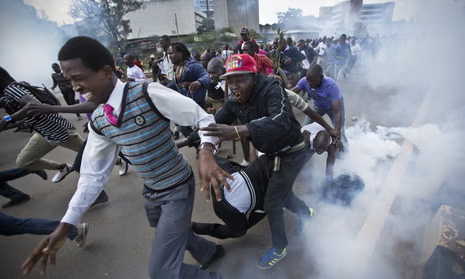
The National Police Service (NPS) has confirmed the arrest of seven individuals connected to the violent disturbances that rocked the Kariobangi North PCEA Church on Sunday, November 30. What was meant to be a solemn thanksgiving service quickly escalated into turmoil, forcing police officers to fire warning shots and deploy teargas in a place of worship.
According to the communiqué from NPS, the suspects — Charles Otieno Opiyo, Wilson Okoth alias M.C. Otieno, Michael Mutunga Kavulunze, Brian Omondi Odhiambo alias Bryo, Reggy Opiyo Otwole, Elisha Otieno Ochieng, and Gordon Odhiambo Onyango — were apprehended in the Lucky Summer area as part of an ongoing investigation into politically-linked incitement and public disorder.
Chaos in the House of Worship
During the service, attended by former Deputy President Rigathi Gachagua and newly-elected Kariobangi North MCA David Warui, tensions soared when two rival youth factions began hurling accusations and verbal attacks at each other. Efforts by police officers to act as mediators failed, prompting the use of riot-control measures, including teargas — a move that has since sparked public criticism.
Churchgoers, including elderly congregants and children, were caught in the confusion, with many forced to evacuate the sanctuary to escape the choking fumes. Videos of coughing worshippers and overturned pews have circulated widely online, with many Kenyans calling the incident both disrespectful and deeply concerning.
Political Accusations and Fallout
Rigathi Gachagua did not mince words following the disruption. He accused President William Ruto and Nairobi Governor Johnson Sakaja of orchestrating the chaos by allegedly hiring goons and police personnel to sabotage the thanksgiving meeting.
His remarks have added a highly political layer to the investigation, reflecting ongoing fractures within Kenya’s political landscape — particularly between the former DP and current leadership.
Meanwhile, the Nairobi Regional Police Commander, alongside the Directorate of Criminal Investigations (DCI), has launched an intensified probe into the chaos. Authorities are now investigating whether the disturbances were premeditated and politically motivated, or simply youthful flare-ups fueled by local rivalries.
Public Reaction and National Concern
Many Kenyans have expressed outrage at the idea of violence infiltrating a place of worship, especially during a thanksgiving ceremony. Religious leaders have urged restraint, respect for sacred spaces, and a return to civil political engagement.
Others are asking bigger questions:
-
How did political rivalries find their way into the sanctity of a church?
-
Were these youths mobilized, or did tensions spontaneously ignite?
-
Will the investigation be conducted transparently and impartially?
Looking Ahead
As the legal process continues and suspects are interrogated, the Kariobangi incident will likely remain a point of national discussion. It serves as a stark reminder of how deeply entrenched Kenya’s political divisions are — and the urgent need for peaceful dialogue rather than confrontation.
DCP’s Triple Victory: How Gachagua’s Party Is Redefining Grassroots Politics in Kenya

The Democracy for Citizens Party (DCP) led by Rigathi Gachagua has won three MCA seats in recent by-elections, signaling a shifting political mood as Kenyan voters turn toward integrity-driven leadership and community-focused governance.
Notably, these wins came at the expense of the ruling party UDA and the long-established ODM, signaling voter willingness to explore new political alternatives. Political commentators suggest that DCP’s success can be attributed to its messaging around economic fairness, anti-bribery, and citizen-empowered governance.
Gachagua’s public appreciation of voters “rejecting voter bribery” wasn’t just a congratulatory note—it was a subtle political jab. Kenya’s elections have historically been marred by allegations of cash incentives, gift distribution, and other forms of electoral influence. By framing the DCP victories as a triumph of integrity over corruption, Gachagua is attempting to brand the party as an ethical alternative—one rooted in principles rather than political muscle.
This narrative resonates in wards like Kariobangi North and Narok Town, where citizens often express frustration over politicians who disappear after securing office. DCP’s messaging seems to tap into a growing sentiment: voters want accountability, fairness, and visible local development.
Unlike the national-level political discourse dominated by big personalities and power struggles, these ward-level races are heavily influenced by everyday concerns:
-
infrastructure and road repairs
-
business permits and market support
-
security
-
water access and sanitation
-
youth unemployment
DCP candidates campaigned on hyper-local promises, speaking directly to community needs rather than engaging in broad national rhetoric. That strategy appears to have paid off.
What’s Next for DCP?
As the party celebrates, the real work begins. Winning seats is one thing—delivering on campaign promises is another. The elected MCAs will be closely watched to see whether DCP can back up its anti-corruption stance with practical results on the ground.
Politically, these victories may encourage more aspirants to run on DCP tickets in future elections. If the trend continues, Gachagua’s party might evolve into a pivotal power broker—especially in Mount Kenya and Rift Valley regions where political loyalties are shifting.
Final Thoughts
The 2025 by-elections didn’t just fill three MCA seats—they revealed a changing political mood in Kenya. Citizens are signaling they’re ready to reward new voices, new parties, and new approaches. DCP’s triple win may be only the beginning of a broader realignment.

The security detail of Trans Nzoia governor George Natembeya has been withdrawn.

The withdrawal of security personnel assigned to Trans Nzoia Governor George Natembeya has sparked heightened political tension and concern over the safety of the county’s top leadership. According to the governor, officers who were guarding his official residence and escort detail were pulled out at exactly midnight on Wednesday, leaving him fully exposed despite recent threats.
This move comes just days after the governor and his entourage were violently attacked on Saturday, November 22, during a political engagement at Chwele Ward in Kabuchai, Bungoma County. Armed individuals are reported to have ambushed the governor, damaging vehicles and obstructing the event. The same group allegedly proceeded to vandalize the residence of Kabuchai Member of Parliament Majimbo Kalasinga.
Images and video from the scene trended widely online, showing shattered windscreens and bullet-riddled frames of the governor’s motorcade. Natembeya claims he narrowly escaped serious harm after the attackers shot at him repeatedly as they disrupted the rally.
The incident has now evolved into a fresh battleground in the longstanding political rivalry between Natembeya and National Assembly Speaker Moses Wetangula. The governor has publicly accused Wetangula of orchestrating the violence and misusing state resources for political intimidation.
Speaking as he toured the damaged Kalasinga homestead, Natembeya strongly condemned the incident:
“This is so primitive, it is not politics,” he said. “Wabunge wa Kenya, huyu ndio Chairman wenu anafanya mambo kama hii… Your leader in the National Assembly is the one doing these things. Sending goons to come and destroy the home of a member of the National Assembly… because they have a different political opinion.”
The events have triggered public debate over the weaponization of state institutions, the fragility of political tolerance, and the growing trend of intimidation in Kenya’s local politics. Citizens and governance observers are also questioning why security was withdrawn from a governor precisely at a time of heightened threat, and whether this decision was influenced by political pressure.
As investigations continue, the situation underscores the urgent need for political decency, accountability, and reforms in how security is allocated to public officials — especially in volatile environments.

Presidential aspirant Fred Matiang’i has doubled down on his pledge to streamline government operations,

saying his administration would immediately prioritize creating a lean, efficient, and accountable system of governance.
Speaking during an interview with NTV on Wednesday, Matiang’i said Kenya has for years suffered the consequences of an oversized and poorly managed government, which he claims has allowed wastage of public resources, duplication of roles, and unchecked spending to thrive.
According to the former Interior Cabinet Secretary, the country’s leadership continues to fall victim to poor governance structures, largely because no administration has been bold enough to confront the “chronic proliferation of government spending.” He argued that resources that could be used to uplift key sectors such as healthcare, education, infrastructure, and social welfare end up being wasted on “unnecessary payments and inflated government structures.”
Matiang’i criticized the current administration led by President William Ruto, accusing it of misplaced priorities and spending patterns that do not reflect the urgent needs of ordinary Kenyans.
He noted that the government has made “overwhelmingly illogical payments,” a trend he believes has deepened public frustration and mistrust.
“The kind of country we have right now, I don’t understand the size of government we have. It is a drain on government resources,” Matiang’i said. “Sometimes, poor prioritization of government programmes is the simplest way you cut waste.”
He emphasized that restoring fiscal discipline would be at the heart of his leadership agenda. His proposed solution includes reducing unnecessary government positions, merging overlapping departments, enforcing strict expenditure controls, and introducing modern accountability systems to ensure transparency in every sector.
Matiang’i also hinted that a lean government would not only save billions but also improve service delivery, accelerate development, and rebuild public confidence in national institutions.
As the 2027 race continues to take shape, Matiang’i’s message appears aimed at voters tired of corruption, bloated government offices, and unchecked spending — issues that have been at the center of Kenya’s governance debate for decades.

ODM Leaders Unite to Protect Raila Odinga Against Misinformation

Homa Bay Governor Gladys Wanga and several ODM Members of Parliament have come out strongly in defense of Azimio leader Raila Odinga, dismissing ongoing rumors and speculation surrounding his health.
Speaking during the Sigand Nyi Nam cultural event in Siaya County on Sunday, Governor Wanga emphasized that Raila Odinga remains in good health and continues to command respect and influence across the country. She accused certain political leaders of deliberately spreading false information to distract Kenyans from key national issues.
“Baba is strong, healthy, and focused. Those who are busy fabricating stories about his health are doing so out of fear and political frustration,” said Wanga.
The governor took a direct swipe at Deputy President Rigathi Gachagua, criticizing him for what she described as “divisive and tribal politics” that undermine national unity. She urged leaders to focus on service delivery and development instead of engaging in personal attacks against opposition figures.
Several ODM MPs who attended the event echoed Wanga’s sentiments, reaffirming their unwavering support for Raila Odinga and warning against attempts to sow discord within the Azimio coalition. They also used the platform to call for respect and political maturity ahead of future elections.
The Sigand Nyi Nam event brought together leaders, cultural groups, and community members from across Nyanza, celebrating unity and heritage while also serving as a stage for strong political statements in defense of Raila’s leadership.
In summary:
Governor Gladys Wanga and ODM allies have made it clear — Raila Odinga’s health is not in question, and any claims suggesting otherwise are nothing but political propaganda meant to divide Kenyans.

United Opposition Issues Fresh Demands to IEBC Ahead of November By-Elections

The United Opposition has put the Independent Electoral and Boundaries Commission (IEBC) on notice, releasing a list of fresh demands that it says are critical for safeguarding electoral justice in Kenya.
In a strongly worded letter addressed to the Commission, the Opposition accused the electoral body of breaching constitutional provisions and failing to meet its mandate of transparency and accountability. The coalition insists that unless IEBC acts swiftly, public trust in the electoral process could be eroded further.
According to the statement, the demands seek to compel IEBC to disclose vital information on electoral preparedness, including:
-
Clear communication on election timelines for the upcoming 24 by-elections scheduled for November 27, 2025.
-
Transparency in voter register management, with the Opposition calling for the immediate release of updated voters’ lists for scrutiny.
-
Disclosure of procurement processes, particularly regarding ballot papers, electronic systems, and other election materials.
-
Public assurance on technology use, with emphasis on secure and verifiable electronic transmission of results.
-
Accountability on staffing and training, to ensure that all presiding officers and clerks are competent, impartial, and well-prepared.
The Opposition argues that these measures are not only constitutional but also essential in restoring public confidence after previous elections were marred by allegations of irregularities, poor communication, and technical failures.
“IEBC must operate as a transparent referee, not as a shadowy institution shielded from scrutiny. Disclosing this information is not optional; it is a constitutional obligation,” part of the letter reads.
The by-elections, set for November, will be a crucial test for both the electoral body and political parties. For IEBC, they represent an opportunity to prove that it can conduct free, fair, and credible polls. For the Opposition, the elections are a chance to mobilize support and test their influence in different regions.
Political analysts note that the Opposition’s demands reflect a wider concern among Kenyans over electoral integrity and fairness. With trust in institutions under constant debate, the IEBC’s response in the coming weeks will likely shape the political atmosphere ahead of the polls.

Ruto Pushes Back at Critics, Says Kenya Is on the Right Track

President William Ruto has defended his administration against mounting criticism over its performance, insisting that Kenya is on the right track. Speaking during a recent address, Ruto emphasized that his government is implementing long-term measures that will ultimately transform the country’s economy despite the current hardships being felt by many citizens.
The President pointed to ongoing reforms in agriculture, housing, healthcare, and digital innovation as proof that his administration is laying a strong foundation for sustainable growth. According to him, critics are impatient and unwilling to acknowledge the gradual progress being made, preferring instead to focus on short-term challenges such as high living costs and taxation pressures.
Ruto also highlighted that major infrastructure projects and policy shifts are beginning to bear fruit, citing reduced import dependence in agriculture, expansion of affordable housing units, and increased youth participation in the digital economy. He urged Kenyans to remain patient, assuring them that his government’s policies are designed to benefit future generations.
However, his remarks come at a time when opposition leaders, civil society groups, and sections of the public have expressed growing dissatisfaction with the rising cost of living, heavy taxation, and perceived slow delivery of campaign promises. Critics argue that the government has failed to prioritize the plight of ordinary citizens, instead focusing on ambitious projects that have yet to deliver tangible results.
Despite the pushback, Ruto maintained that his leadership remains committed to steering Kenya toward economic stability and growth. He reiterated his belief that tough reforms are necessary to restore fiscal discipline, attract investment, and secure long-term prosperity for the country.
As debates continue, one thing is clear: Ruto’s administration will be judged not only on its promises but also on the lived realities of Kenyans in the months and years ahead.