by muckbivi83
Mike Sonko Steps In: 110 Mothers Freed From Hospital Detention at Mama Lucy Kibaki Hospital
In a heartwarming act of generosity, former Nairobi Governor Mike Sonko has once again come to the rescue of struggling families. Sonko has settled the hospital bills for 110 mothers who had been detained at Mama Lucy Kibaki Hospital due to unpaid medical fees. The mothers, who had been unable to clear their maternity and treatment costs, can now return home to their families—thanks to Sonko’s timely intervention.
Sonko made the announcement after personally visiting the hospital, where he cleared the outstanding bills and pledged to cover the mothers’ future medical expenses. He stated that no mother should have to suffer or be separated from her newborn simply because of financial challenges.
“These women have already gone through enough pain bringing life into the world. It’s inhumane to detain them because they can’t afford hospital bills,” Sonko said. “I have settled all their balances and will ensure they receive any follow-up care they need without worrying about payment.”
This act of compassion has drawn praise across social media, where many Kenyans lauded Sonko for his continued efforts to support vulnerable communities. Over the years, Sonko has built a reputation for his philanthropy—helping families in distress, covering medical bills, rescuing accident victims, and even supporting education for needy students.
The situation at Mama Lucy Kibaki Hospital had reportedly drawn concern after reports emerged that dozens of mothers were being held for weeks due to unpaid balances. Sonko’s move has not only reunited these women with their loved ones but also reignited a national conversation about healthcare affordability and the treatment of low-income patients in public hospitals.
As the freed mothers return home, many have expressed deep gratitude to Sonko, describing his gesture as a “miracle” and a “lifeline.”
“We had lost hope, but Sonko came through for us. May God bless him,” said one of the mothers who had been detained for two weeks.
With this latest act of kindness, Mike Sonko continues to demonstrate the power of empathy and leadership rooted in action. His intervention at Mama Lucy is not just about paying bills—it’s about restoring dignity, hope, and compassion in the heart of Nairobi.


Tragedy in Murang’a: Mother Allegedly Drowns Her Two Children in River Mathioya

A heartbreaking incident has shaken residents of Kiharu, Murang’a County, after a 24-year-old woman allegedly drowned her two young children in River Mathioya. The children, aged seven and one, reportedly met their tragic end on Wednesday evening, leaving the community in deep shock and grief.
According to area residents, the woman was seen heading toward the river with her children before disappearing for several hours. When she returned alone, concerned neighbors questioned her about the whereabouts of the children. It was then that she allegedly confessed to having thrown them into the river.
Local authorities and divers from the county disaster response team have since launched a search and recovery operation to retrieve the bodies. However, as of Thursday morning, the efforts had not yet yielded results due to the river’s strong currents and high water levels.
Murang’a County Police Commander confirmed the incident, saying the suspect has been taken into custody and is assisting detectives with investigations. He added that the motive behind the shocking act remains unclear, but preliminary reports suggest the woman may have been struggling with personal or psychological issues.
The community has been left devastated, with leaders calling for increased mental health awareness and support systems, especially for young mothers facing emotional or economic hardship.
“It’s a very painful and disturbing tragedy. We urge families and neighbors to be more vigilant and to offer support when someone appears overwhelmed,” said one local leader.
This tragic event adds to a worrying rise in domestic-related killings and child abuse cases in the country, raising questions about the accessibility of mental health care and social support services for struggling families.
Authorities are continuing their search for the bodies and have assured the public that justice will be pursued once investigations are complete.

UK Issues Caution Over Alcohol Safety in Kenya

The United Kingdom has added Kenya to its travel advisory list of countries where British citizens are urged to exercise caution when consuming alcoholic beverages. This follows growing concerns over cases of methanol poisoning linked to counterfeit or tainted alcohol sold in local bars and shops.
In its updated guidance, the UK Foreign, Commonwealth & Development Office (FCDO) warned travellers to be vigilant about what and where they drink, citing reports of illegally brewed or fake branded alcohol that may contain toxic levels of methanol—a substance that can cause blindness, organ failure, or death if consumed.
Kenya has in recent months reported several incidents of fatal alcohol poisoning, particularly in informal settlements and rural areas where cheap spirits and unlicensed brews are common. Local authorities have launched crackdowns and suspended licenses of some outlets found selling unregulated drinks.
The advisory encourages visitors to avoid unsealed bottles, purchase alcohol only from reputable establishments, and steer clear of homemade or street-sold brews. It also emphasizes seeking immediate medical attention in case of symptoms such as nausea, headache, blurred vision, or dizziness after drinking.
This move could affect tourism and nightlife sectors in Kenya, especially in popular destinations such as Nairobi, Mombasa, and Naivasha, where entertainment hubs thrive on both local and international visitors.
As the government steps up efforts to combat counterfeit alcohol production, health experts continue to urge public awareness on the dangers of consuming unverified drinks — a problem that has long plagued Kenya’s alcohol market.

Blow to Government as Court Halts Enforcement of New Cybercrimes Law

The government has suffered a major setback after the High Court issued temporary orders suspending the implementation of the Computer Misuse and Cybercrimes (Amendment) Act, 2025, pending the full hearing and determination of a petition challenging its legality.
The controversial law, which was set to take effect this month, introduced tougher penalties for online offenses, including defamation, misinformation, and hate speech, while also giving the state expanded powers to block websites and monitor digital activity.
However, several civil rights groups and digital advocacy organizations moved to court, arguing that the amendments infringe on freedom of expression, privacy, and media rights as protected by the Constitution. They claim the new provisions could be used to silence dissent and stifle free speech under the guise of combating cybercrime.
Justice [insert name if known] granted interim orders stopping the government from enforcing the law until the petition is heard and determined. The ruling means that authorities cannot arrest, charge, or prosecute individuals under the new provisions of the amended Act.
The case has sparked national debate, with some supporting the government’s efforts to curb cyberbullying, online fraud, and digital misinformation, while others see the amendments as a threat to democracy and digital freedom.
The hearing of the case is expected to begin in the coming weeks, with digital rights groups vowing to fight what they call “a creeping attempt to control Kenya’s online space.”

DCI Dismisses Reports of Re-Arrest of Kware Murder Suspect Collins Jumaisi


The Directorate of Criminal Investigations (DCI) has refuted reports circulating online that claim Collins Jumaisi Khalusha — the main suspect in the gruesome Kware murders — has been re-arrested.
In a statement issued earlier today, the DCI termed the reports as false and misleading, urging the public to disregard the claims and rely only on official communication channels for verified updates.
Jumaisi, who was in police custody in connection with a series of brutal murders that left residents of Kware in shock, escaped under unclear circumstances last week. His disappearance has raised serious questions about the security and accountability within law enforcement, prompting calls for a thorough internal investigation.
The suspect is accused of being behind multiple killings that sparked fear and outrage in the densely populated Nairobi estate. Residents have since demanded justice for the victims and greater protection from rising insecurity in the area.
Authorities say a manhunt for Jumaisi is still ongoing, with specialized units deployed to track his whereabouts. The DCI has assured the public that all efforts are being made to bring him back into custody and ensure he faces justice.
Meanwhile, social media has been awash with speculation and unverified claims about the suspect’s alleged re-arrest, forcing the DCI to step in and clarify the matter.
“We urge members of the public to avoid spreading misinformation that may jeopardize ongoing investigations,” read part of the DCI statement.
The Kware murders remain one of the most chilling cases in recent months, exposing both the fragility of public safety systems and the urgent need for stronger oversight in handling dangerous suspects.

Uganda Sets 2026 Election Date as Museveni Eyes Nearly 50 Years in Power

Uganda’s Electoral Commission has officially announced that the country’s next general election will be held on January 15, 2026, setting the stage for a high-stakes political contest. President Yoweri Museveni, who has been in power since 1986, is expected to seek re-election — a move that could extend his rule to nearly half a century.
Museveni, now in his 80s, remains one of Africa’s longest-serving leaders. His government has been accused by opposition figures and human rights groups of curbing political freedoms and using state institutions to maintain power. However, his supporters credit him with bringing stability and economic progress after years of turmoil.
The opposition, led by figures such as Bobi Wine, has vowed to challenge Museveni’s continued rule, calling for free and fair elections and an end to what they describe as “dictatorship under the guise of democracy.”
As the 2026 elections approach, Uganda faces growing pressure both domestically and internationally to ensure transparency, respect for human rights, and a peaceful electoral process. All eyes will be on how the Electoral Commission manages the polls and whether the results will reflect the will of the people.

Mejja postpones his first-ever album to 2026, promising pure Genge vibes and timeless sound.

Kenyan music legend Mejja Genge has officially confirmed that his highly anticipated debut album has been postponed to 2026. The project, which has been in the works for the past two years, was initially expected to drop later this year but will now take a little longer as Mejja perfects the final touches.
In a statement shared online, Mejja expressed that the delay is meant to ensure that fans get the best version of the Genge sound — the authentic, street-rooted style that has defined his career for over a decade. He assured supporters that the extra time will allow him to fine-tune the production, collaborations, and overall vibe of the album, describing it as his “biggest and most personal project yet.”
Fans across Kenya and beyond have been eagerly waiting for a full-length project from Mejja, whose consistency and storytelling have made him one of the most beloved figures in Kenyan music. Known for hits like Siskii, Kanairo Dating, and Toboa, the star has continued to dominate the airwaves and shape the direction of Genge music.
While no official title or release date has been announced, Mejja hinted that the album will include fresh collaborations, nostalgic Genge elements, and a touch of his signature humor and storytelling.
“This one is for the real Genge fans,” Mejja said. “We’re making something timeless. 2026 will be worth the wait.”
Fans can expect teasers, singles, and possibly behind-the-scenes content in the lead-up to the album’s official release — proving once again that Mejja remains the heart and soul of modern Genge.

It’s Exam Season! 2025 KCSE Kicks Off with Over 960,000 Candidates Ready to Shine

The 2025 Kenya Certificate of Secondary Education (KCSE) exams officially kicked off today, marking a crucial milestone for thousands of students across the country. According to the Kenya National Examinations Council (KNEC), a total of over 960,000 candidates are sitting for the national tests in more than 10,000 examination centers nationwide.
The examinations began with foreign and sign language orals, paving the way for practical papers scheduled between October 22 and 31. Thereafter, the written examinations will take place from November 4 to 21, signaling the final academic hurdle for Form Four candidates before transitioning to tertiary institutions or the job market.
Education officials have assured the public that all measures have been put in place to ensure integrity, security, and fairness throughout the exam period. The Ministry of Education, in collaboration with security agencies, has deployed supervisors and invigilators across all counties to oversee smooth administration of the papers.
Speaking during the official launch of the exams, Education Cabinet Secretary Ezekiel Machogu urged candidates to remain calm and confident, reminding them that the KCSE is not just a test of knowledge but also of discipline and determination. He further cautioned against any form of examination malpractice, emphasizing that the government has adopted advanced surveillance systems to detect and prevent cheating.
Parents and teachers across the country have also expressed their support and encouragement, hoping for excellent results that will open new opportunities for the young learners.
This year’s KCSE is especially significant as it marks the second cohort of candidates sitting under the revised Competency-Based Curriculum (CBC) aligned structure, which aims to emphasize skills, innovation, and holistic education.
As the exams continue, the focus remains on ensuring that every candidate is given an equal chance to demonstrate their hard work and potential.
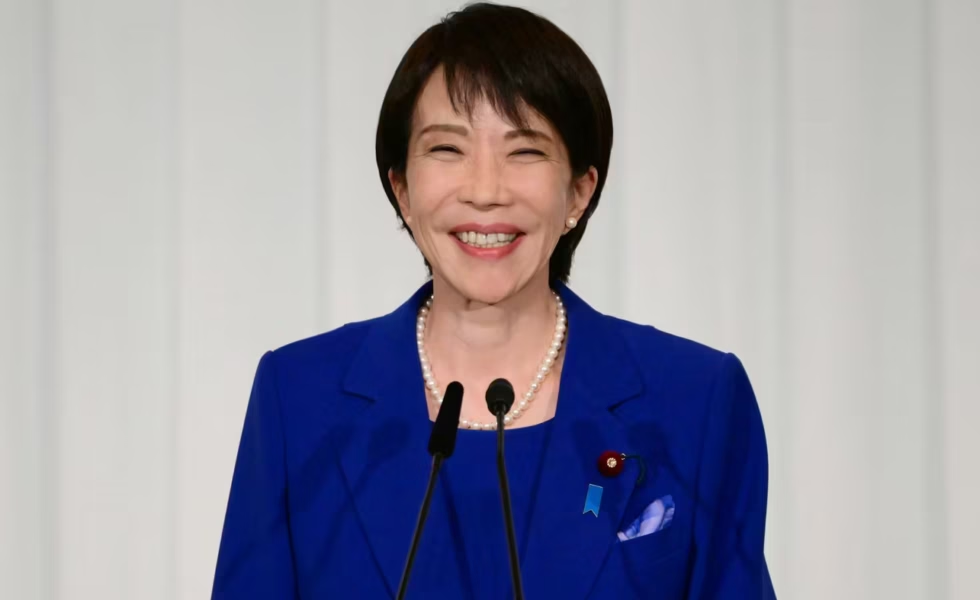
A Historic Shift: Sanae Takaichi Becomes Japan’s First Woman Prime Minister
On October 21, 2025, Japan’s parliament made history, electing Sanae Takaichi as the country’s first female prime minister. At age 64, she will formally assume office after meeting the emperor — a constitutional tradition in Japan — marking a symbolic and literal inauguration of a new era.
While the moment is being widely celebrated, it is fraught with contradictions, challenges, and uncertainties. Below is a deep dive into the significance, the hurdles, and what to watch for in the coming days.
From LDP Leadership to the Premiership
Takaichi first secured the leadership of the Liberal Democratic Party (LDP) on October 4, 2025, becoming the first woman to lead the party.
In that internal election, she outpaced longtime favorites like Shinjiro Koizumi, riding a base of ideological support within the party.
However, her path to the prime minister’s office was not smooth. The LDP’s traditional coalition partner, Komeito, withdrew support, citing discomfort with her leadership and ideological stances.secure a viable majority, Takaichi negotiated a coalition with the right-wing Japan Innovation Party (Ishin no Kai) — a pact that became crucial for her election. In the Lower House vote, she won 237 out of 465 seats — a narrow but decisive margin above the 233 needed for a majority. The next step is formal affirmation by the Upper House and then the swearing-in.

President Samia Accused of Instilling Fear Through Abductions & Arrests

As Tanzania approaches its October 2025 general elections, the political atmosphere is being described by human rights groups, opposition parties, and international observers as one of escalating repression and shrinking democratic space. Under President Samia Suluhu Hassan’s watch, serious allegations have emerged: enforced disappearances, extrajudicial killings, arbitrary arrests, and the exclusion of major opposition figures from the presidential contest. The question looms large—are Tanzanians witnessing democracy’s unraveling?
According to a recent briefing by Amnesty International, the Tanzanian government is accused of instilling a climate of fear through systemic human rights abuses.
he report documents cases of abductions, enforced disappearances, unlawful killings, torture, and ill-treatment of critics and political opponents. As of August 2024, the Tanganyika Law Society documented 83 missing persons under suspicious circumstances.In one incident, Ali Mohammed Kibao, a senior strategist for the opposition party Chadema, was abducted from a bus and his body later discovered dumped near the Indian Ocean.
Several other party activists and youth leaders have vanished after being picked up by uniformed or plain-clothed agents, and many remain unaccounted for.
The authorities have yet to produce transparent, credible investigations, and, in most cases, no one has been held accountable.