 by muckbivi83
Seven Arrested After Kariobangi Church Chaos as Political Tensions Intensify


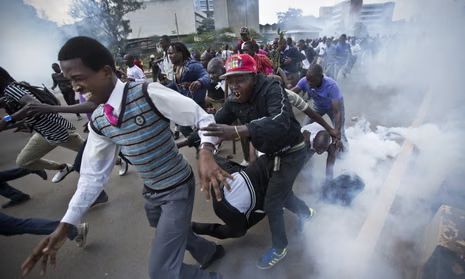
The National Police Service (NPS) has confirmed the arrest of seven individuals connected to the violent disturbances that rocked the Kariobangi North PCEA Church on Sunday, November 30. What was meant to be a solemn thanksgiving service quickly escalated into turmoil, forcing police officers to fire warning shots and deploy teargas in a place of worship.
According to the communiqué from NPS, the suspects — Charles Otieno Opiyo, Wilson Okoth alias M.C. Otieno, Michael Mutunga Kavulunze, Brian Omondi Odhiambo alias Bryo, Reggy Opiyo Otwole, Elisha Otieno Ochieng, and Gordon Odhiambo Onyango — were apprehended in the Lucky Summer area as part of an ongoing investigation into politically-linked incitement and public disorder.
Chaos in the House of Worship
During the service, attended by former Deputy President Rigathi Gachagua and newly-elected Kariobangi North MCA David Warui, tensions soared when two rival youth factions began hurling accusations and verbal attacks at each other. Efforts by police officers to act as mediators failed, prompting the use of riot-control measures, including teargas — a move that has since sparked public criticism.
Churchgoers, including elderly congregants and children, were caught in the confusion, with many forced to evacuate the sanctuary to escape the choking fumes. Videos of coughing worshippers and overturned pews have circulated widely online, with many Kenyans calling the incident both disrespectful and deeply concerning.
Political Accusations and Fallout
Rigathi Gachagua did not mince words following the disruption. He accused President William Ruto and Nairobi Governor Johnson Sakaja of orchestrating the chaos by allegedly hiring goons and police personnel to sabotage the thanksgiving meeting.
His remarks have added a highly political layer to the investigation, reflecting ongoing fractures within Kenya’s political landscape — particularly between the former DP and current leadership.
Meanwhile, the Nairobi Regional Police Commander, alongside the Directorate of Criminal Investigations (DCI), has launched an intensified probe into the chaos. Authorities are now investigating whether the disturbances were premeditated and politically motivated, or simply youthful flare-ups fueled by local rivalries.
Public Reaction and National Concern
Many Kenyans have expressed outrage at the idea of violence infiltrating a place of worship, especially during a thanksgiving ceremony. Religious leaders have urged restraint, respect for sacred spaces, and a return to civil political engagement.
Others are asking bigger questions:
-
How did political rivalries find their way into the sanctity of a church?
-
Were these youths mobilized, or did tensions spontaneously ignite?
-
Will the investigation be conducted transparently and impartially?
Looking Ahead
As the legal process continues and suspects are interrogated, the Kariobangi incident will likely remain a point of national discussion. It serves as a stark reminder of how deeply entrenched Kenya’s political divisions are — and the urgent need for peaceful dialogue rather than confrontation.

KDF Denies Claims of Stolen Meth After Historic Ksh. 8.2B Drug Seizure
 Kenya’s security agencies are pushing back firmly against allegations of misconduct within the ranks of the Kenya Defence Forces (KDF) following a major narcotics seizure in late October. The controversy erupted after claims surfaced suggesting that some military personnel may have siphoned off part of the confiscated drugs for personal profit — allegations that KDF now categorically denies.

A High-Stakes Interception on Open Waters
The incident stems from an October 25, 2025 operation in which a dhow moving through the western Indian Ocean was intercepted after coordinated surveillance by Kenyan authorities and international intelligence partners. Onboard, officers discovered 1,024 kilograms of crystal meth, reportedly worth over Ksh. 8.2 billion on the illegal market.
The seizure involved a joint task force consisting of:
-
The Kenya Navy
-
The Kenya Coast Guard Service
-
NACADA (National Authority for the Campaign Against Alcohol and Drug Abuse)
Six Iranian nationals suspected to be trafficking the shipment were arrested and remain in custody pending further legal procedures.
Where the Controversy Began
As the seized methamphetamine was brought to shore, accusations emerged claiming some KDF personnel may have pilfered part of the narcotics in an attempted cover-up and resale scheme.
This prompted widespread speculation online and within certain media spaces — speculation KDF asserts is unfounded.
In their official statement, KDF emphasized transparency and accountability:
“The entire 1,024 kilograms of methamphetamine offloaded ashore remains intact and is under continuous, round-the-clock protection by a dedicated multi-agency security team.”
Investigations Underway — No Impunity
Importantly, the military acknowledges that the allegations are being looked into seriously. KDF confirmed that internal investigations are ongoing, noting that:
“Should the allegations be substantiated, appropriate disciplinary and legal measures will be taken in accordance with the law.”
This signals that while KDF rejects the claims publicly, it is allowing investigative bodies — likely the Military Police, DCI, and relevant agencies — to conduct independent reviews and audits of the operation.
What This Means for Kenya’s Anti-Drug War
This incident highlights several key issues:
-
Kenya’s Indian Ocean waters are a major drug trafficking corridor for cartels moving meth and heroin toward East Africa and Europe.
-
Multi-agency collaboration is increasingly essential in maritime narcotics enforcement.
-
Public trust in official institutions — especially the military — is critical and fragile.
-
Transparency and follow-through in investigations will determine public confidence going forward.
Final Thoughts
As the case unfolds, the question isn’t just whether KDF officers stole part of the drug consignment — it’s about whether Kenya’s institutions can demonstrate integrity, accountability, and credibility in handling one of the biggest narcotics seizures in the country’s history.

Tragic Death of Nairobi Taxi Driver During Passenger Dispute

Police in Nairobi are investigating a shocking incident that left a taxi driver dead after a passenger allegedly attacked him during a dispute in Kitisuru.
Kenneth Kimani Gachoka, a well-known taxi driver in the city, reportedly picked up a passenger from a petrol station in Westlands and drove him to Chrisco Christian Church. Upon arrival, a disagreement ensued between the two, during which the passenger allegedly stabbed Gachoka in the neck.
Despite the severity of his injuries, Gachoka managed to escape the scene and alert fellow drivers, who quickly rushed him to the hospital. Tragically, he was pronounced dead on arrival.
The incident has left many in shock, highlighting the dangers that taxi and ride-hailing drivers face while on duty. Police have launched an investigation into the attack, and efforts are underway to track down the suspect.
Authorities are appealing to anyone who witnessed the altercation or has information about the suspect to come forward. Meanwhile, the local taxi community is mourning the loss of one of their own, calling for stricter security measures to protect drivers from similar attacks in the future.
This tragic case underscores the need for greater safety protocols for drivers and passengers alike. It also raises pressing questions about conflict resolution and public safety in busy urban areas like Nairobi.

Kenya Faces Concerning Surge in HIV Infections: A Call to Action

Kenya’s recent HIV statistics present a worrying trend that demands national attention, public discussion, and renewed prevention strategies. The 2025 World Aids Day report by the National Syndemic Disease Control Council shows a 19% rise in new HIV infections from 16,752 cases in 2023 to 19,991 in 2024. This spike signals not only medical concerns but also social, economic, and behavioral challenges affecting communities across the country.
Counties with the highest new cases include:
-
Nairobi – 3,045
-
Migori – 1,572
-
Kisumu – 1,341
-
Homa Bay – 1,180
-
Busia – 886
These counties many of which border Lake Victoria have historically recorded higher HIV prevalence due to cultural, economic, and demographic factors.
Even more alarming is the disproportionate impact on young people aged 15–34, who represent 74% of all new infections. Within this group, young women are particularly vulnerable, recording significantly higher infection rates than their male counterparts. This underscores persistent gender-related risk factors, including unequal relationships, limited sexual health education, economic vulnerability, and transactional relationships.
Nationally, Kenya’s HIV prevalence stands at 3%, affecting 1.3 million people, including many children infected through mother-to-child transmission or early-life vulnerabilities. Tragically, HIV related deaths climbed to 21,007, up from 18,473 the previous year a reversal after years of improvement due to wider access to antiretrovirals.
On the global scale, Kenya now ranks 8th among countries with the highest HIV burden, sharing the list with:
-
South Africa
-
India
-
Mozambique
-
Nigeria
-
Tanzania
-
Uganda
-
Zambia
This ranking reinforces the reality that HIV remains both a national and international public health challenge.
What Needs to Change?
Experts emphasize several critical interventions:
-
Expanded access to testing and counseling
-
Targeted sexual health education for youth
-
Reducing stigma to encourage testing and treatment
-
Greater support for young women and adolescents
-
Strengthening community-level awareness campaigns
-
Improving access to PrEP and HIV prevention tools
The fight against HIV requires a combined effort from government, healthcare providers, educators, religious leaders, and communities.
A Human Story Behind the Numbers
Beyond the statistics are real people individuals, families, and communities navigating the realities of life with HIV. The rise in infections and deaths is not merely a chart trend; it is a mirror reflecting social behaviors, economic inequalities, cultural attitudes, and healthcare gaps.
DCP’s Triple Victory: How Gachagua’s Party Is Redefining Grassroots Politics in Kenya

The Democracy for Citizens Party (DCP) led by Rigathi Gachagua has won three MCA seats in recent by-elections, signaling a shifting political mood as Kenyan voters turn toward integrity-driven leadership and community-focused governance.
Notably, these wins came at the expense of the ruling party UDA and the long-established ODM, signaling voter willingness to explore new political alternatives. Political commentators suggest that DCP’s success can be attributed to its messaging around economic fairness, anti-bribery, and citizen-empowered governance.
Gachagua’s public appreciation of voters “rejecting voter bribery” wasn’t just a congratulatory note—it was a subtle political jab. Kenya’s elections have historically been marred by allegations of cash incentives, gift distribution, and other forms of electoral influence. By framing the DCP victories as a triumph of integrity over corruption, Gachagua is attempting to brand the party as an ethical alternative—one rooted in principles rather than political muscle.
This narrative resonates in wards like Kariobangi North and Narok Town, where citizens often express frustration over politicians who disappear after securing office. DCP’s messaging seems to tap into a growing sentiment: voters want accountability, fairness, and visible local development.
Unlike the national-level political discourse dominated by big personalities and power struggles, these ward-level races are heavily influenced by everyday concerns:
-
infrastructure and road repairs
-
business permits and market support
-
security
-
water access and sanitation
-
youth unemployment
DCP candidates campaigned on hyper-local promises, speaking directly to community needs rather than engaging in broad national rhetoric. That strategy appears to have paid off.
What’s Next for DCP?
As the party celebrates, the real work begins. Winning seats is one thing—delivering on campaign promises is another. The elected MCAs will be closely watched to see whether DCP can back up its anti-corruption stance with practical results on the ground.
Politically, these victories may encourage more aspirants to run on DCP tickets in future elections. If the trend continues, Gachagua’s party might evolve into a pivotal power broker—especially in Mount Kenya and Rift Valley regions where political loyalties are shifting.
Final Thoughts
The 2025 by-elections didn’t just fill three MCA seats—they revealed a changing political mood in Kenya. Citizens are signaling they’re ready to reward new voices, new parties, and new approaches. DCP’s triple win may be only the beginning of a broader realignment.

Vatican Reaffirms “One Spouse for Life” in Historic Decree

In a historic announcement on Tuesday, the Vatican has issued a global decree emphasizing that Catholics should commit to a single spouse for life. Approved by Pope Leo, the directive reinforces the Church’s teaching that marriage is a sacred, lifelong union between one man and one woman.
The decree, released by the Vatican’s Congregation for the Doctrine of the Faith, addresses growing concerns about marital fidelity and challenges posed by the practice of polygamy, especially in parts of Africa where some Catholics follow cultural traditions involving multiple committed relationships. The Church warns that these practices contradict Catholic marriage rules and may undermine the spiritual and social stability of the family.
According to Church officials, marriage is not only a social contract but a spiritual covenant, reflecting God’s design for human relationships. The decree stresses that the sacrament of marriage carries responsibilities that extend beyond physical companionship to moral and spiritual unity.
The Vatican also highlighted the need for education and pastoral guidance in regions where polygamy persists. Priests are encouraged to counsel couples and families, emphasizing that fidelity and monogamy strengthen personal growth, family stability, and alignment with Catholic doctrine.
This decree comes amid debates in the global Church about modern relationships, cultural practices, and the importance of lifelong commitment in marriage. While some traditions may view multiple partners as socially acceptable, the Vatican insists that spiritual wellbeing and adherence to Church teachings should take precedence.
Experts predict that this directive will spark conversations among African Catholic communities, where polygamy has historical roots. Church leaders are expected to focus on reconciling cultural traditions with the Church’s understanding of marriage, emphasizing faithfulness, love, and lifelong commitment as pillars of Catholic family life.

Gloria Ntzola spent over KSh 1.8M on cosmetic surgery in Nigeria

Influencer Gloria Ntzola has sparked intense conversation online after revealing that she spent over KSh 1.8 million on cosmetic surgery in Lagos, Nigeria. Her expenses covered the surgical procedure, a luxury hotel stay during recovery, post-operation medical care, and additional treatments she undertook to maintain the final results.
According to Gloria, the decision to go under the knife was something she had contemplated for years. But while many assume cosmetic procedures are easy and glamorous, she emphasized that the experience was physically demanding, painful, and emotionally taxing.
She bravely shared vivid details about the healing journey — from swelling and restricted mobility to the intense aftercare requirements. Gloria also mentioned the pressure many influencers face to present “perfect” bodies, often driven by intense online scrutiny and unrealistic beauty standards.
However, her most powerful message was a warning:
“You could lose your life. If you’re thinking of doing this, please do your research and be sure this is what you want.”
Her confession has triggered discussions about body image, the growing cosmetic surgery trend among East African influencers, and the personal and medical risks that people rarely speak about.
Many of her followers praised her transparency, calling her story a wake-up call amid the rising popularity of surgical body enhancements seen on social media. Others expressed concern that such openness may normalize expensive and potentially risky procedures among young people seeking validation.
Gloria insists she does not regret the procedure — but she regrets the fear, pain, and risk that came with it. And her advice remains clear:
Think critically, research thoroughly, choose qualified surgeons, and above all — make sure your decision comes from self-love, not social pressure.

The security detail of Trans Nzoia governor George Natembeya has been withdrawn.

The withdrawal of security personnel assigned to Trans Nzoia Governor George Natembeya has sparked heightened political tension and concern over the safety of the county’s top leadership. According to the governor, officers who were guarding his official residence and escort detail were pulled out at exactly midnight on Wednesday, leaving him fully exposed despite recent threats.
This move comes just days after the governor and his entourage were violently attacked on Saturday, November 22, during a political engagement at Chwele Ward in Kabuchai, Bungoma County. Armed individuals are reported to have ambushed the governor, damaging vehicles and obstructing the event. The same group allegedly proceeded to vandalize the residence of Kabuchai Member of Parliament Majimbo Kalasinga.
Images and video from the scene trended widely online, showing shattered windscreens and bullet-riddled frames of the governor’s motorcade. Natembeya claims he narrowly escaped serious harm after the attackers shot at him repeatedly as they disrupted the rally.
The incident has now evolved into a fresh battleground in the longstanding political rivalry between Natembeya and National Assembly Speaker Moses Wetangula. The governor has publicly accused Wetangula of orchestrating the violence and misusing state resources for political intimidation.
Speaking as he toured the damaged Kalasinga homestead, Natembeya strongly condemned the incident:
“This is so primitive, it is not politics,” he said. “Wabunge wa Kenya, huyu ndio Chairman wenu anafanya mambo kama hii… Your leader in the National Assembly is the one doing these things. Sending goons to come and destroy the home of a member of the National Assembly… because they have a different political opinion.”
The events have triggered public debate over the weaponization of state institutions, the fragility of political tolerance, and the growing trend of intimidation in Kenya’s local politics. Citizens and governance observers are also questioning why security was withdrawn from a governor precisely at a time of heightened threat, and whether this decision was influenced by political pressure.
As investigations continue, the situation underscores the urgent need for political decency, accountability, and reforms in how security is allocated to public officials — especially in volatile environments.

Ruthless Arsenal Crush Tottenham 4–1: A Derby to Remember
First-Half Dominance: Arsenal Set the Tone

Arsenal came into the match hungry, aggressive, and fully dialed into the derby atmosphere. From the first whistle, the Gunners pressed high and forced Tottenham into rushed decisions. Their quick interchanges between midfield and attack created gaps that Spurs struggled to contain.
The first goal—arriving after sustained pressure—lifted the Emirates into full voice. Arsenal dictated tempo, possession, and physicality, while Tottenham spent large portions of the half pinned inside their own half, dealing with wave after wave of red shirts.
Tottenham’s Struggle & Brief Hope


Tottenham eventually found a moment to breathe and tested Arsenal’s backline. Their goal seemed at first like it could spark a comeback—just enough life to stir belief among the Spurs faithful. But the hope was short-lived. Arsenal responded with composure and aggression, refusing to let the game tip toward chaos.
Tottenham’s main issue was decision-making in the final third. They were too predictable, too reactive, and too frequently crowded out by Arsenal’s defensive structure. Even when they found space wide, their final delivery rarely troubled the keeper.
Second-Half: Arsenal Turn Ruthless


The final 45 minutes became a statement of intent from Arsenal. They struck with conviction, piling on the goals and dismantling Tottenham’s confidence. Every counterattack felt like a threat. Every corner felt like a chance. Every Arsenal touch carried conviction.
As the fourth goal hit the back of the net, the Emirates exploded. Spurs, meanwhile, looked emotionally and tactically beaten—reduced to desperate defending and long-ball attempts that never materialized into real danger.
Final Whistle: A Derby Owned by Arsenal
When the match ended 4–1, there was no doubt who had owned the day. Arsenal were sharper in midfield, deadlier in attack, and more disciplined at the back. The Gunners didn’t just win; they imposed their identity on the pitch.
For Tottenham, this was more than just a loss—it was a reality check. Their defensive frailties were exposed, and their limited creativity in transition was glaring.

President Museveni Hosts Prime CS Musalia Mudavadi for High-Level Talks on Regional Stability and Indian Ocean Security

Ugandan President Yoweri Kaguta Museveni on Thursday hosted Kenya’s Prime Cabinet Secretary and Cabinet Secretary for Foreign and Diaspora Affairs, Musalia Mudavadi, for a high-level consultative meeting focused on strengthening regional stability and advancing shared interests within the East African Community (EAC).
According to sources familiar with the meeting, the discussion centred on emerging geopolitical challenges, trade facilitation, cross-border cooperation, and the growing strategic importance of the Indian Ocean as a regional economic and security hub.
Mudavadi, who has been playing an increasingly central role in Kenya’s foreign policy and regional diplomacy, held the talks at State House Entebbe where both leaders underscored the need for joint approaches to address evolving threats, including maritime security, terrorism, illicit trade, and the safeguarding of regional trade routes.
Key Areas Discussed
1. Indian Ocean Security and Blue Economy Agenda
The leaders reportedly discussed the ongoing concerns around the Indian Ocean’s security environment, especially as competition over maritime resources intensifies. Both Kenya and Uganda rely heavily on ports along the Indian Ocean for imports and exports, making maritime stability crucial. The conversation touched on:
-
Securing supply chains and shipping routes,
-
Strengthening the Blue Economy framework within the EAC,
-
Combating illegal fishing and maritime crimes,
-
Enhancing regional naval cooperation.
2. Trade and Infrastructure Integration
Museveni and Mudavadi also explored ways to expand regional trade corridors, including the Northern Corridor and the development of railway and road infrastructure linking Mombasa to Uganda. Improving logistical efficiency and reducing non-tariff barriers remain top priorities for both countries.
3. Regional Peace and Diplomatic Coordination
With ongoing tensions and conflicts in parts of the Great Lakes region and the Horn of Africa, the leaders emphasised the importance of coordinated diplomacy. Discussions included:
-
South Sudan’s peace process,
-
Stability efforts in Eastern DRC,
-
Joint actions against extremist groups,
-
Strengthening EAC diplomatic alignment.
Why This Meeting Matters
The meeting comes at a time when East Africa faces shifting geopolitical dynamics—from global power competition over the Indian Ocean to the economic pressures facing regional markets. Mudavadi’s visit reinforces Kenya’s commitment to robust regional alliances and signals the growing role of diplomacy in solving shared challenges.
It also highlights the deepening relationship between Nairobi and Kampala, two nations that continue to drive EAC economic and political integration.