

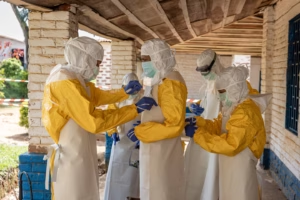

Kenya’s High Court has temporarily halted plans for the establishment of an Ebola quarantine facility in the country under an arrangement involving the United States government. The decision came after Katiba Institute successfully secured interim conservatory orders challenging the legality and transparency of the proposed arrangement.
In the ruling, the court barred the Kenyan government from establishing, approving, or facilitating any Ebola quarantine, isolation, or treatment facility linked to the US or any other foreign government until the case is fully heard and determined. The court further stopped the entry or transfer into Kenya of individuals exposed to or infected with Ebola under the disputed agreement.
The move has sparked widespread public debate across Kenya, with many citizens raising concerns about public health safety, national sovereignty, and the transparency of international agreements involving sensitive health matters. Critics argue that Kenya should prioritize protecting its citizens and ensuring all health-related partnerships undergo public participation and parliamentary oversight before implementation.


Katiba Institute, a constitutional and governance watchdog, moved to court seeking clarity and accountability regarding the reported plans. The organization questioned whether the government followed constitutional procedures before engaging in discussions related to the proposed Ebola quarantine facility.
The High Court’s interim orders now place the controversial plans on hold pending further legal directions. According to the court, the matter will be mentioned again on June 2, 2026, when further directions regarding the hearing of the case will be issued.
The ruling comes at a time when global health preparedness remains a major concern following recent outbreaks of infectious diseases around the world. While governments often collaborate internationally to strengthen disease response systems, such partnerships can become controversial when issues of transparency, public consent, and national interest arise.
Health experts have also weighed in on the issue, emphasizing the importance of balancing international cooperation with local public health priorities. Some experts argue that Kenya must maintain strong disease surveillance and emergency preparedness systems without compromising public trust.
As the case proceeds in court, many Kenyans will be closely following the outcome, which could shape future international health agreements and policies in the country. The High Court’s decision has already intensified discussions on how Kenya handles foreign partnerships in critical sectors such as healthcare and public safety.